

Versiti - Hospital & Medical Partners | Versiti Organ, Tissue & Eye Donation
Explore our service lines

Hospital & Medical Partners

With your help, we can serve Wisconsin patients who desperately need organ and tissue transplants.

Professional Resources


Versiti is one of 55 federally designated organ procurement organizations (OPO). It is the OPO’s responsibility to assess donor potential, authorize donation, manage organ allocation, order any necessary testing and procure organs at the donor hospital.

It is imperative that hospitals and organ donation organizations work together to facilitate donation in the most effective, impactful way to maximize each donor’s anatomical gift(s). Versiti’s service area covers 12 counties and roughly 2.3 million Wisconsin residents. 


Referral Line | 24 Hours
  • 800-432-5405
  • General Information
  • 414-937-6999
  • Nikki Chalsma
    Manager of Hospital Development and Family Support

    Clinical Triggers

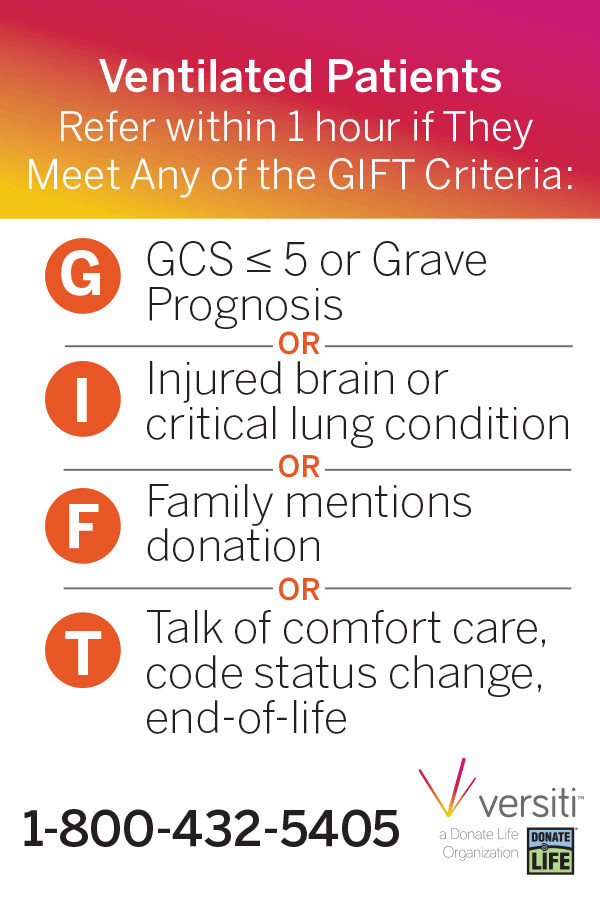
    For all patients, call immediately at cardiac time of death, even if a ventilated patient was referred for one of the following triggers:

    • GCS ≤ 5 or Grave Prognosis, or
    • Injured brain or critical lung condition, or
    • Family mentions donation, or
    • Talk to comfort care, code status change, end-of-life

    Clinical Trigger Flyer

    Organ Donation Pathways


    Surgeons involved with Versiti and transplant centers cannot be a part of the death declaration or end-of-life care. Brain death determination, cardiac cessation (asystole or PEA) and declaration in DCD donors must be completed by hospital physicians.

    DBD donors are ventilated patients who have suffered severe neurological injuries and have been declared dead by neurological criteria.

    DCD donors are ventilated patients who have suffered severe injuries but have some brain stem reflexes intact, therefore not meeting brain death criteria. These patients have poor prognoses and would not be able to sustain life without external support. The decision has been made to transition to withdraw life-sustaining therapies, including ventilator support.

    Transplantable Organs and Recoverable Tissues

    • Heart
    • Intestines
    • Kidneys
    • Liver
    • Lungs
    • Pancreas

    • Bone: used to treat patients with orthopedic cancers, damaged spines and damaged joints
    • Tendons and ligaments: used for joint reconstruction and repair of sports injuries
    • Skin: used to treat burns, for breast reconstructions following mastectomies, and for wound treatment
    • Veins and arteries: used to treat those suffering from diabetes and vascular diseases
    • Heart valves: used to repair damaged or diseased heart valves
    • Corneas: used to replace damaged or diseased corneas to improve eyesight

    Tools & Resources


    Brain Death Testing Resources

    Refer to this published article on Pediatric and Adult Brain/Death by Nerologic Criteria for consensus guidelines.


    Glasgow Coma Scale

    Guide to the Glasgow Coma Scale (GCS): history, scoring, and clinical use in assessing brain injury and patient consciousness.


    Community Resources

    Versiti Organ and Tissue offers several resources, outreach programs and educational opportunities that encourage communities to support organ, tissue and eye donation.
     

    Champions of Hope

    More than 100,000 people in the United States are waiting for a lifesaving organ transplant. For them, hope doesn’t come from chance, it comes from people who choose to act.

    Frequently Asked Questions

    Only Versiti staff will discuss donation with family or legal next of kin, unless otherwise instructed.

    Versiti follows United Network for Organ Sharing (UNOS) matching per federal legislation. Recipients and donors are matched based on medical factors including blood type, HLA typing, body size, etc. These medical attributes are entered into an algorithm that provides potential recipients that have the best chance of long-term survival. Potential recipients are organized into a list based on how sick they are and how close their transplant center is to the donor hospital.

    You may be told the region in the U.S. where organs were transplanted; however, we cannot share the exact location or transplant center.

    Yes. All ventilated patients who meet clinical triggers need to be referred to Versiti within one hour of the patient meeting the clinical trigger. Referrals are necessary even if patients will be transferred to another unit or out of the hospital. Versiti always hopes that patients improve and are positively extubated; however, as the organ procurement organization, we must evaluate all donation potential in real time so that we are prepared for the time-sensitive process of donation.

    Versiti will follow in the background until the patient improves, is no longer a candidate, or the time arises for a donation conversation with the patient’s next of kin. A Versiti staff member will check in every day to monitor neurological status, family plan and overall patient condition. It is the hospital’s responsibility to update Versiti if a patient loses neurological reflexes, their condition worsens, or if family/medical plan of care changes.

     

    The Vital Role of Coroners and Medical Examiners

    Coroners and medical examiners (C/MEs) play a vital role in supporting families during some of the most challenging moments following the loss of a loved one. As trusted partners in the community, C/ME collaboration in the organ, tissue, and eye donation process helps honor the wishes of individuals who chose to be donors or empowers families to make that decision on their behalf. This decision provides opportunity to save and heal countless lives.

    Versiti works closely with C/MEs to ensure that donation is facilitated with the utmost respect for the investigative process. Together, donor suitability is assessed and necessary clearances to avoid interfering with cause and manner of death determinations are established in order to provide families the option to donate.

    This partnership not only enhances the quality of life for transplant recipients but also provides donor families with a sense of comfort and purpose, knowing their loved one’s legacy lives on through the gift of donation.

    Referral Process

    Tissue Donor Referral Triage

    Age Criteria:
    Male: 0-80 years
    Female: 0-75 years

    Age limits vary for tissue types and are subject to change. Contact Versiti for further evaluation when in question.

    Timing Criteria:
    Tissue excision must commence within 24 hours of last known alive time if the decedent was cooled within 12 hours.

    Tissue excision must commence within 15 hours of last known alive time if the decedent has not been cooled within 12 hours.

    Tissue Donor Referral Triage

    Rule Our Criteria:

    • HIV/Aids
    • History of Metastatic Cancer
    • Hepatitis B & C
    • History of Alzheimer's Disease or Dementia
    • Sepsis
    • Known IV Drug Use (within the last 5 years)
    • Incarceration for more than 72 consecutive hours in the last 12 months
    • Male to male sexual contact within the last 5 years

    Call to make referral:
    1-888-278-0556

    Jenny Schroeter

    Jenny Schroeter

    Coroner/Medical Examiner Liaison

    jschroeter@versiti.org

    262-488-7535