

Emani King
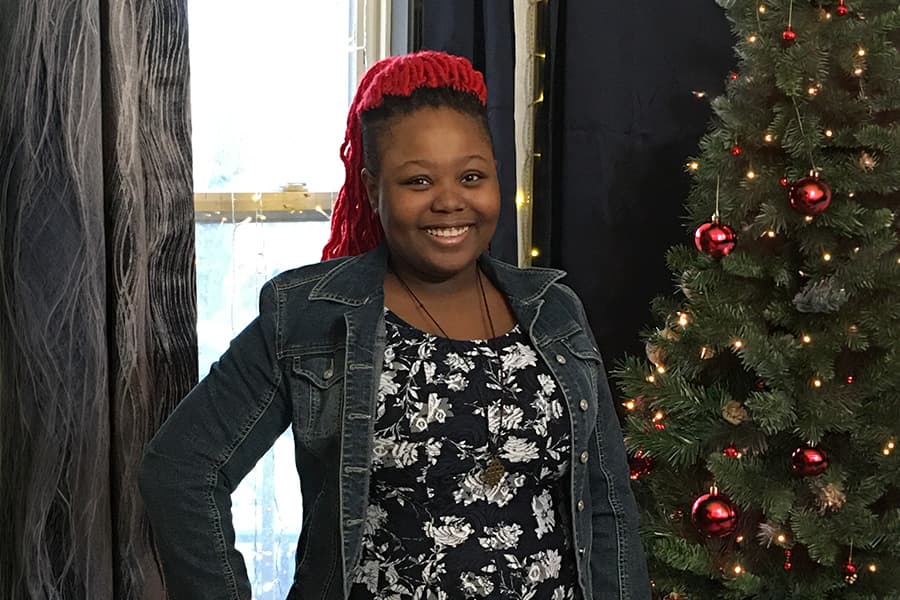
Emani King
On December 13, 2000, Emani entered the world, and Elizabeth King knew her daughter was something special. Indeed, her very existence seems miraculous in many ways. Soon after Elizabeth gave birth, the nurses ran the usual routine newborn tests. Unfortunately, the tests discovered something out of the ordinary. Emani was only a few hours old, and she’d already been diagnosed with a serious health condition—sickle cell disease (SCD-SS), the most severe form of sickle cell.
“I had never heard of sickle cell before,” Elizabeth recalled, “All I heard was the word ‘disease,’ and as a new mom, that terrified me.”
Elizabeth had every right to feel frightened. After all, Emani’s diagnosis was quite serious. Doctors feared she might experience severe deformities and delayed growth. Worse still, they told Elizabeth that Emani may not live past her fourth birthday.
The doctors were wrong.
“[Emani] is now 24,” Elizabeth said. “By the grace of God and the prayers of the righteous, Emani did not suffer with any deformities or delayed growth at all.”
Although Emani did not have what most would call a normal childhood, with being hospitalized for weeks and even months at a time, she nonetheless went on to lead a fulfilling life. Despite her SCD, she completed elementary and high school. But there were health challenges, and they began young.
Between the ages of 4 and 6, Emani dealt with acute chest syndrome (ACS), a serious complication from SCD that can cause problems such as trouble breathing and chest pain—symptoms that led doctors to treat her for asthma. The older Emani got, the less she experienced ACS. Unfortunately, other issues emerged, like debilitating bone pain, and migraines.
“When she was in high school, she got really bad migraines,” Elizabeth said. “I remember being in the middle of the Walmart with my brother, and Emani. She got lightheaded, and the lights in Walmart were so bright that they triggered her migraines.
Later, a visit to the doctor revealed that Emani had four blood clots on her brain, also known as Deep Vein Thrombosis (DVT). Now, in addition to the blood transfusions, she also needed blood thinners to reduce her chances of a stroke.
That set the tone for most of Emani’s childhood and teen years, a series of hospitalizations, doctor visits, and scheduled blood transfusions. During middle school, Emani required monthly transfusions just to function. To make matters more complicated, the hospital couldn’t always find a compatible donor, which meant longer hospital stays.
“The process could take a long time because it was hard for them to find a match for her,” Elizabeth said. “She has a lot of antibodies in her blood. So when they draw her blood, they have to do a cross-match with other units of blood. They have to make sure it's as close as possible to the antibodies she has—because if not, her body can reject the blood transfusion.”
Thankfully, Emani no longer requires a monthly transfusion. This opened the possibility for Emani to fulfill her dream of going to college. This was especially exciting for Emani because she was accepted to the Culinary Institute of America in California. Over the years, she had developed a love for cooking, so she decided to pursue a career in the culinary arts.
“She wants to be a personal chef someday,” Elizabeth said. “She loves the business side of it too—so culinary arts and business management.”
When she was a freshman in high school, she missed more days than expected due to a long hospitalization, which delayed her graduation until December 2019. However, Emani’s school held a special graduation ceremony just for her. Her teachers celebrated Emani for never giving up and showing true strength and resilience.
“She was the only graduate,” Elizabeth said. “The high school staff filled the library room and presented her with gifts.”
Knowing Emani’s dream of becoming a chef, they also presented her with a personalized apron and recipe book. “It was really special,” Elizabeth said.
Sadly, Emani needed to pause college. Shortly after starting, the doctors found a brain aneurysm. On top of the aneurysm, Emani learned she also has astigmatism in both eyes, brought on by the SCD. Essentially, astigmatism causes blurry vision. Combined with Emani’s fairly frequent hospital stays, chronic fatigue and pain, as well as the costly bureaucracy of health insurance, it’s hard to keep appointments.
Yet, both Emani and Elizabeth make it a point not to simply dwell on the negative. Emani still plans on returning to college. There are pastries to bake and new recipes to learn. She’s also found solace in reading manga, watching anime, and jamming out to K-pop. And when her SCD is in check, Emani will go for a relaxing swim.
More importantly, Emani and Elizabeth have their faith, family, and the hope that things will get better. Plus, Elizabeth credits Emani for giving her the drive to succeed. Emani motivated Elizabeth to complete her college degree, encouraged her to get her driver’s license, and inspired her to buy a home. Today, Elizabeth feels blessed to have a successful job she loves.
“If it wasn’t for Emani, there are a lot of things I wouldn’t have done,” Elizabeth said. “I wouldn’t have gotten my driver’s license, but I had a daughter who told me when she was eight years old, ‘Mama, you need to get your license, so we don’t have to keep waiting on people [to drive us]!’ ”
In honor of her daughter’s encouraging spirit, Elizabeth would like to share a request: Sickle cell patients need blood.
“I spent a large portion of my time in the hospital with Emani,” Elizabeth said. “At the time, I didn’t understand why we had to wait so many hours—sometimes even days—for her to get a blood transfusion. When I asked, they explained how hard it is to find a match for her blood.”
Emani’s experience is, unfortunately, too common. On average, only 5% of the U.S. population donates blood. Of that 5%, only a fraction are eligible donors for SCD patients.
“I can only speak from my experience,” Elizabeth said. “It’s not easy watching your child—or anyone you love—suffer in pain while waiting for blood. There are so many people living with conditions they can’t control. If their bodies can’t produce healthy blood cells and ours can, then we’re blessed to be able to share it.”
Every day, patients with sickle cell disease count on transfusions for their very survival. For Emani, that’s a reality she lives with every day. And for parents like Elizabeth, it means becoming a steadfast advocate for blood donation.
“If and when you’re able, please become a blood donor,” Elizabeth said. “You never know how helpful or whose life your blood might save. It starts with just one pint. Will that pint come from you?”
Your Blood Can Help Someone Thrive
For many people living with sickle cell disease, donated blood is more than a treatment. It can mean more time at home with family, more days at school or work, and more opportunities to enjoy the moments that make life meaningful.
People with sickle cell disease need blood transfusions throughout their lives. Closely matched blood can help make those transfusions safer and more effective. That is why donors from every background are needed, and why African American donors can play an especially meaningful role. Certain blood characteristics that can be important for people with sickle cell disease are more commonly found in donors with shared ancestry.
When you donate blood with Versiti, your gift may directly support someone living with sickle cell disease or another patient who depends on donated blood. You become part of a community of care helping people feel stronger, stay healthier and live fuller lives.
Schedule an appointment today. Your blood could be the match someone has been waiting for.