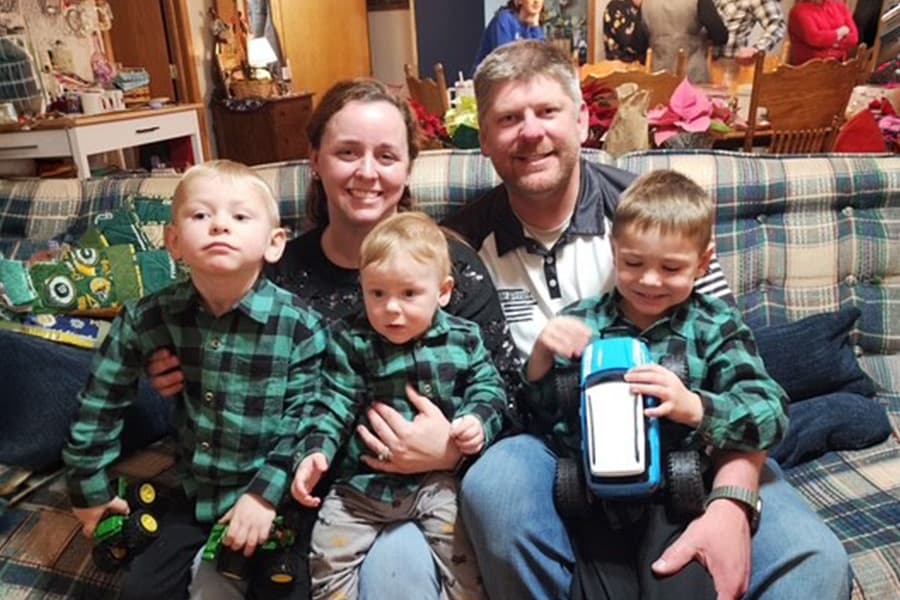
If Kaitlyn Lemke were to summarize her life in one word, perhaps it would be “busy.”
“We live on the family farm where my husband’s mom grew up,” she said. “We farm the land and have various farm animals, including chickens, goats, and horses.”
Kaitlyn and her husband also own a semi-truck company that hauls agricultural feed. On top of that, she is a full-time nurse in a neurosurgery clinic. Most importantly, she’s a mom of three little boys, ages 5, 3, and 1.
Kaitlyn was pregnant with her third when she learned about placenta donation. “I think it was during a prenatal visit,” Kaitlyn recalled. “My OB, or a nurse, said, ‘By chance, would you want to donate your placenta?’”
Because she works in healthcare, Kaitlyn knows a thing or two about organ and tissue donations. So she was understandably surprised when she discovered that mothers could donate their placenta.
“When I first talked to the Versiti representative,” Kaitlyn said, “I asked why I was only hearing about this now during my third pregnancy. She explained that because placenta donation is still relatively new, they're only collecting from scheduled C-sections.”
Kaitlyn’s first two pregnancies were routine deliveries, so placenta donation wasn’t an option. Generally, you are approached by an OB or nurse if you qualify. Given the specifics surrounding the placenta donation process, it’s understandable why many mothers haven’t heard of it.
Placenta donations must meet other criteria as well, Kaitlyn explained. “Was the pregnancy uncomplicated? Is it a single birth rather than twins? You also can’t have certain pregnancy-related conditions or diseases.”
However, the donation process is practically seamless, requiring very little extra effort from the mother. Kaitlyn’s OB assured her that collecting the placenta would only add about 15 to 20 minutes to the procedure. It’s one of the reasons why Kaitlyn agreed to donate.
“All I had to do was sign a consent form with Versiti,” she said. “Then it literally just meant there was one extra person in the operating room during my C-section.”
Being a nurse and ever inquisitive, Kaitlyn asked a lot of questions. “I like knowing the why and how behind everything,” she said. The Versiti team explained to her how they’d spend several months testing her placenta and screening for disease. When everything checked out, the placenta tissue would be used for patients with difficult-to-heal wounds, including diabetic ulcers and burns.
Given Kaitlyn’s healthcare background, she understood why placenta donation is so important for patients with diabetic ulcers. “Diabetic ulcers are really, really hard to heal,” she said. “Patients are constantly in pain. Sometimes those ulcers become so severe that amputation becomes necessary.”
Thanks to Kaitlyn and many other mothers, placenta donations can help reduce the severity of such wounds. What was once considered medical waste is now considered a valuable resource.
“Science is constantly evolving, and we're constantly looking for ways to treat disease and help people heal,” Kaitlyn said. “The fact that someone figured this out is honestly amazing.”
When asked what she’d advise expecting mothers deciding whether to donate their placenta, she said, “Do it. As simple as that—just do it. You get to help somebody else with an organ you're never going to use again.”
As a nurse and mother, Kaitlyn is excited to see how placenta donation will continue to advance science and change lives. “Anything that helps people heal is worth pursuing.”
Give the Gift of Healing After Birth
If you have a planned C-section, you may be able to donate your placenta and help patients with serious burns and hard-to-heal wounds. Placenta donation does not affect the birth or medical care of you or your baby, and the placenta is collected after delivery.
Talk with your doctor about how you can participate in Versiti’s placenta donation program, or learn more about placenta donation.